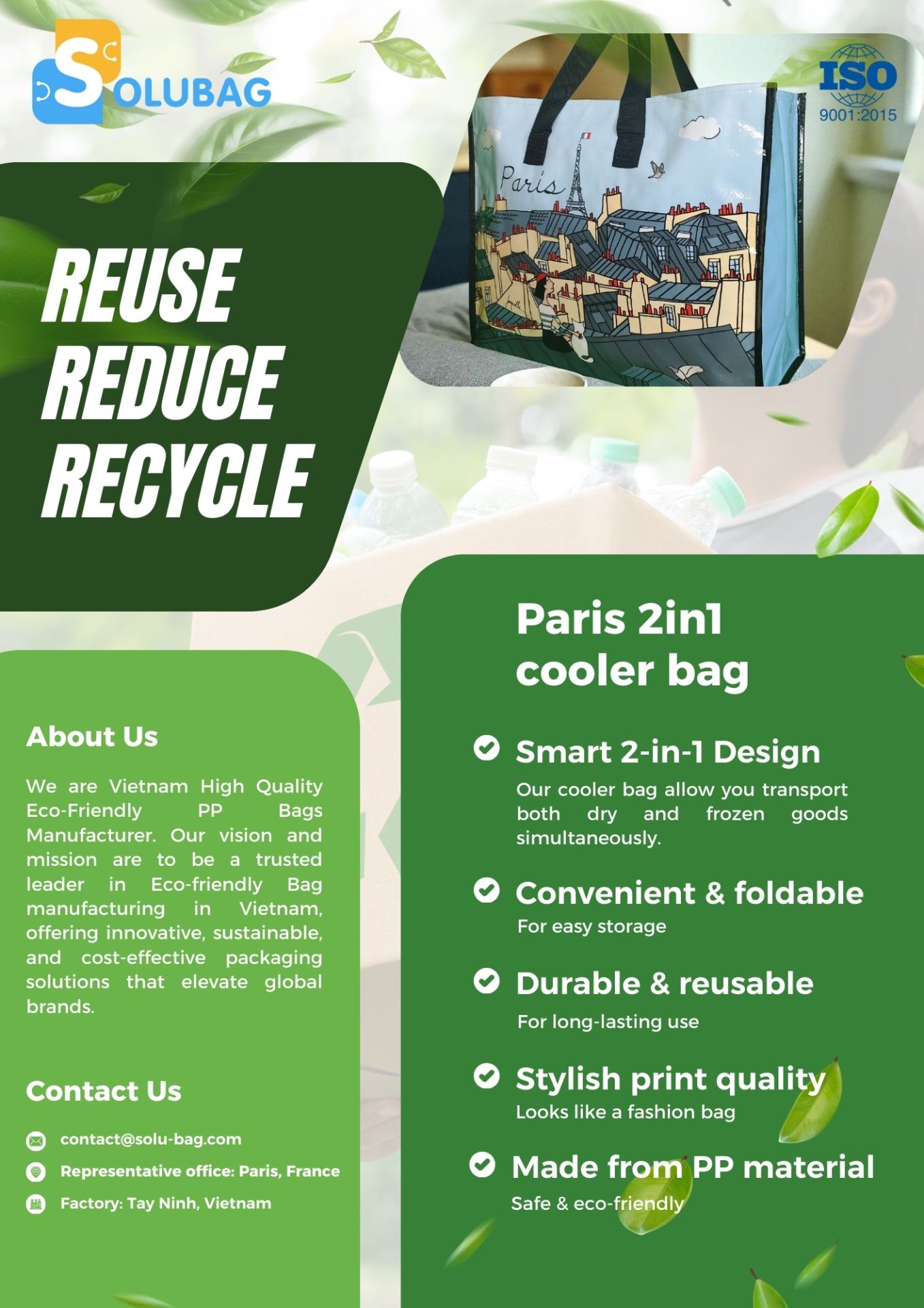

High Quality PP Woven Bags Manufacturer in Vietnam
This article explains how buyers can evaluate a high quality PP woven bags manufacturer in Vietnam, beyond surface claims and product photos. It looks at what quality means in real production conditions, how factories manage consistency, materials, and workmanship, and why quality expectations for PP woven bags are changing in 2026. The focus is on practical indicators that matter for European B2B buyers sourcing reliable, repeatable PP woven bag solutions.

High quality - is one of the most misunderstood words in PP woven bags
Quality is a word everyone uses.
In PP woven bags, it is also one of the least clearly defined.
Some buyers associate quality with thickness.
Others with printing sharpness.
Others with how long a bag lasts in daily use.
From the factory side, quality is none of these alone. It is the ability to deliver the same result, again and again, under different conditions.
A bag can look perfect in one shipment and fail expectations in the next. When that happens, the issue is rarely “bad production.” It is usually weak quality control at system level.
This is why the question is not does this bag look good today?
It is will it still meet expectations six months from now?
Why quality expectations are shifting in 2026
The PP woven bag market is not new.
What is changing is how buyers define acceptable quality.
In recent years, several trends have influenced this shift:
- More focus on reuse rather than single campaigns
- More scrutiny on consistency across multiple orders
- Higher sensitivity to customer complaints and returns
- Pressure to reduce waste caused by short product life
In practice, this means quality is no longer judged only at delivery.
It is judged over time and repetition.
A high quality PP woven bags manufacturer in Vietnam in 2026 is expected to support this longer view.
Quality starts with material discipline, not thickness
One common misunderstanding is that quality equals thicker fabric.
Thickness can help, but it is not the whole story.
Quality in PP woven bags starts with:
- Stable yarn sourcing
- Controlled weaving tension
- Consistent GSM across rolls
- Proper lamination or coating selection
When material variation is not controlled, even thick bags behave unpredictably. Printing shifts. Stitching tension changes. Finished bags feel inconsistent.
Factories that focus on material discipline early usually face fewer downstream problems.
This is not glamorous work.
But it is where real quality begins.
Workmanship: the details buyers notice after delivery
Many quality issues only appear after bags are used, not when they are inspected.
Typical examples include:
- Handles loosening after repeated use
- Side seams opening under load
- Lamination peeling over time
- Printing fading faster than expected
These are not design failures. They are execution details.
A high quality manufacturer pays attention to:
- Stitch density and reinforcement points
- Handle attachment method
- Load distribution, not just static strength
- Compatibility between ink, lamination, and fabric
These choices often increase production time slightly.
But they reduce complaints significantly.
In B2B sourcing, fewer complaints usually matter more than slightly lower unit cost.
Consistency is harder than quality — and more valuable
Producing a good PP woven bag once is not difficult.
Producing it consistently is.
Consistency requires:
- Clear specifications
- Defined tolerances
- Stable operators and training
- Routine checks, not occasional inspections
This is where many factories struggle.
Quality systems help, but systems alone are not enough. They must be used daily, not only during audits.
From experience, consistency problems often appear when:
- Orders are small
- Deadlines are tight
- Designs are slightly modified
A factory that maintains quality under these conditions usually has strong internal discipline.
Small changes reveal quality maturity
One of the best ways to evaluate quality is to observe how a factory handles small changes.
Examples:
- A minor size adjustment
- A different handle color
- A logo repositioned by a few millimeters
Low-maturity factories treat small changes casually.
High-quality factories slow down and confirm details.
This may feel inefficient at first.
In reality, it prevents costly misunderstandings.
Quality is often revealed not by big decisions, but by how small ones are handled.
Quality control vs quality culture
Quality control finds problems.
Quality culture prevents them.
A high quality PP woven bags manufacturer in Vietnam usually shows signs of quality culture:
- Operators understand why steps matter
- Supervisors intervene early, not after failure
- Feedback from previous orders is documented
This culture does not appear overnight. It develops when management values long-term relationships over short-term output.
Buyers can often sense this difference during communication, not only during factory visits.
The role of reusability in quality perception
In 2026, reusability increasingly shapes how quality is judged.
A bag designed for multiple uses is expected to:
- Maintain shape
- Keep handles intact
- Preserve print clarity
Quality, in this context, is linked to real-life performance, not lab testing alone.
Factories that understand this design with margin. They expect bags to be overloaded, dragged, folded, and reused.
This practical mindset aligns well with European retail and promotional use.
Why Vietnam stands out in quality-oriented sourcing
Vietnam’s manufacturing environment sits between scale and flexibility.
Many factories are large enough to manage export standards, but still adaptable enough to handle customized orders and mid-sized volumes.
This balance supports quality in two ways:
- Processes are structured
- Communication remains relatively direct
For buyers seeking high quality PP woven bags, this combination often works better than extremes at either end.
Vietnam does not eliminate quality risk.
It offers conditions where quality can be managed systematically.
Evaluating a high quality PP woven bags manufacturer: a practical checklist
Instead of asking “are you high quality?”, buyers may consider asking:
About materials
- How is GSM variation controlled?
- Are yarn sources stable?
- How are material changes approved?
About workmanship
- How are handles reinforced?
- What load tests are used internally?
- How is stitching consistency monitored?
About repeat orders
- How are specs stored?
- What happens if the same bag is reordered months later?
- How are past issues tracked?
About communication
- Are questions encouraged or avoided?
- Are limitations explained clearly?
- Are decisions documented?
Factories that answer these calmly are often the most reliable.
When “high quality” may be unnecessary
It is worth saying this openly.
Not every project requires top-tier quality.
For short-term promotions or one-time use, basic quality may be sufficient.
Problems arise when expectations and usage do not match the quality level chosen.
A good manufacturer helps buyers make this distinction early.
This honesty often leads to better long-term cooperation.
A reflection from experience
Over time, I have learned that quality problems rarely come from bad intentions. They come from assumptions.
Assumptions about materials.
Assumptions about usage.
Assumptions about tolerance.
High quality manufacturing reduces assumptions.
It replaces them with confirmation.
This approach may feel slower at the beginning.
But it almost always saves time later.
High quality is calm, repeatable execution
A high quality PP woven bags manufacturer in Vietnam is not defined by claims or samples alone. It is defined by how consistently expectations are met across orders, seasons, and changes.
In 2026, quality is less about perfection and more about predictability under real conditions.
For B2B buyers, the better question may not be:
Is this bag high quality?
But rather:
Will this quality level remain stable when my needs change?
The answer to that question usually determines whether a sourcing relationship lasts.
>>> Read more about PP Woven Bags Price – Updated Cost 2026